Click to watch the full architectural walkthrough
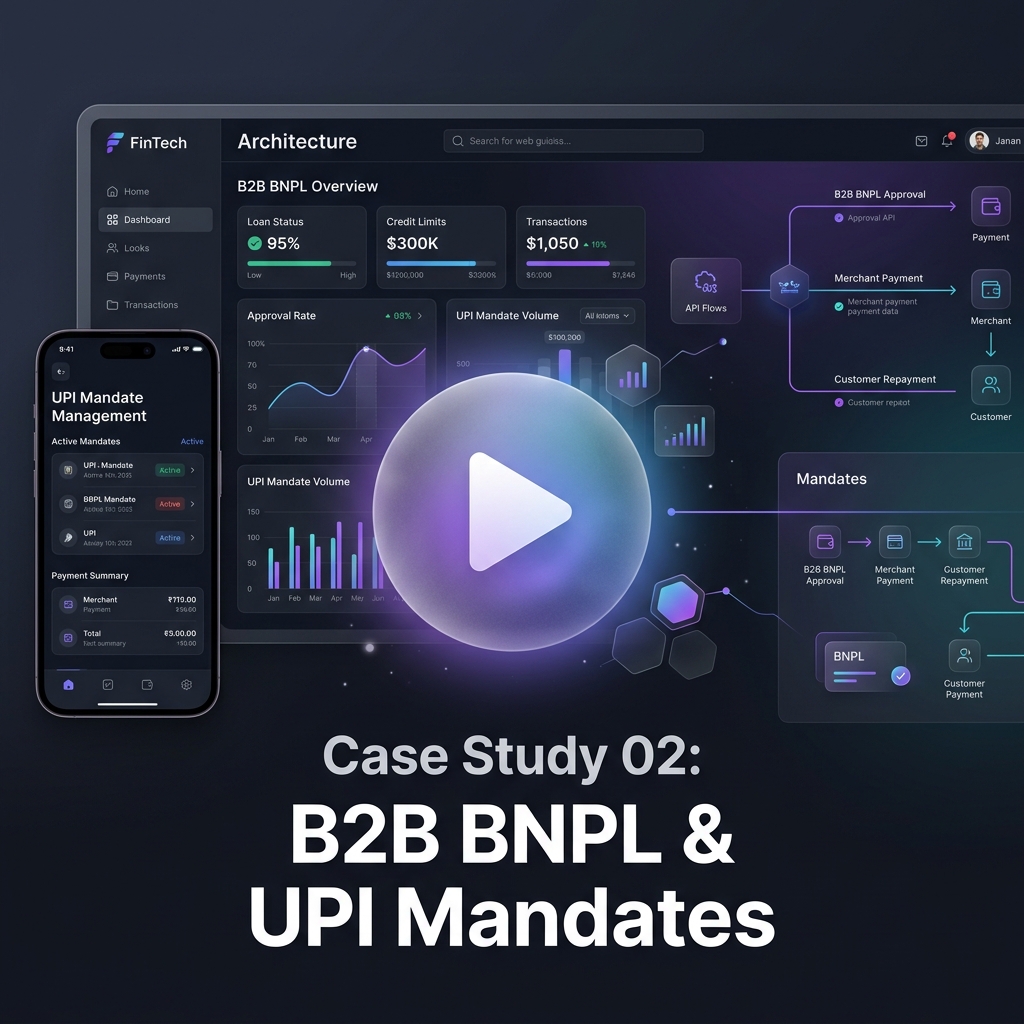
Business Narrative
We are consulting for a massive B2B E-commerce platform. Small retailers frequently add ₹50,000 worth of wholesale inventory to their carts but abandon the purchase at checkout due to a lack of immediate working capital.
To combat this, the platform is introducing a Checkout Credit (BNPL) button.
Regulatory Constraint: Digital Lending Guidelines (DLG)
Because the platform acts solely as a Loan Service Provider (LSP), they cannot lend their own money or let the loan funds touch their corporate accounts. They have partnered with a regulated NBFC (Non-Banking Financial Company) to supply the capital.
The CEO has issued a strict mandate: The entire flow—from clicking BNPL, verifying bank data, completing AI underwriting, setting up repayment mandates, and confirming the order—must execute in under 30 seconds.
Stakeholders
- Retailer (User): Needs ₹50,000 credit instantly at checkout.
- B2B E-commerce Platform (LSP): The frontend interface; must never touch the actual loan funds.
- NBFC (Lender): Provides the ₹50,000 capital and the AI underwriting engine.
- Sponsor Bank: The bank executing the final NEFT disbursal.
- Supplier (Seller): The merchant receiving the ₹50,000 for the goods.
The 30-Second API Pipeline (Happy Path)
Step 1: The Instant Data Fetch (Seconds 0-10)
The user clicks BNPL. We instantly trigger the Account Aggregator (AA) SDK.
- UI: "Share 6 months of bank statements with our lending partner." User enters UPI PIN to approve the Consent Artefact.
- Backend: The user's bank encrypts the data and routes it via the AA. The NBFC decrypts it.
Step 2: AI Underwriting (Seconds 10-15)
- Backend: The NBFC's AI engine parses the raw JSON bank statements, verifying average monthly balance, cheque bounce history, and business cash flow.
- State: The AI fires a
credit_approved: truewebhook to the Loan Origination System (LOS).
Step 3: The Collection Mandate (Seconds 15-25)
- UI: "Approve a ₹10,000 EMI deduction for the 5th of every month." User approves via their preferred UPI App.
- Backend: The NPCI returns a
mandate.successwebhook containing the UMRN (Unique Mandate Reference Number).
Step 4: DLG-Compliant Disbursal (Seconds 25-30)
- Backend: The NBFC fires an API directly to their Sponsor Bank, wiring the ₹50,000 directly to the Supplier's account. This ensures strict DLG compliance.
- UI: "Order Confirmed!"
The Architect's Challenge: Disbursal Failure
You engineer a flawless 30-second Happy Path. But what happens during a severe bank outage?
The Scenario:
The retailer reaches Step 4. They have provided their data, passed underwriting, and successfully registered an active UPI AutoPay mandate with the NPCI.
However, the Sponsor Bank's core banking system experiences a severe timeout. The NEFT fails, returning: DISBURSAL_FAILED_BENEFICIARY_BANK_OFFLINE.
The order cannot be placed, and the goods will not ship.
The Disaster Constraints
- The Active Mandate Liability: The user's UPI mandated is locked and active. If the system does nothing, on the 5th of next month, the user's bank will automatically deduct a ₹10,000 EMI for a loan they never received. This is a severe compliance violation.
- Zero-Touch Rule: You cannot ask the user to manually cancel the mandate inside their payment app. It is poor UX, and manual intervention risks lawsuits if forgotten.
- Automated Recovery: The system must recognize the failure at the tail-end of the pipeline and programmatically reverse the state.